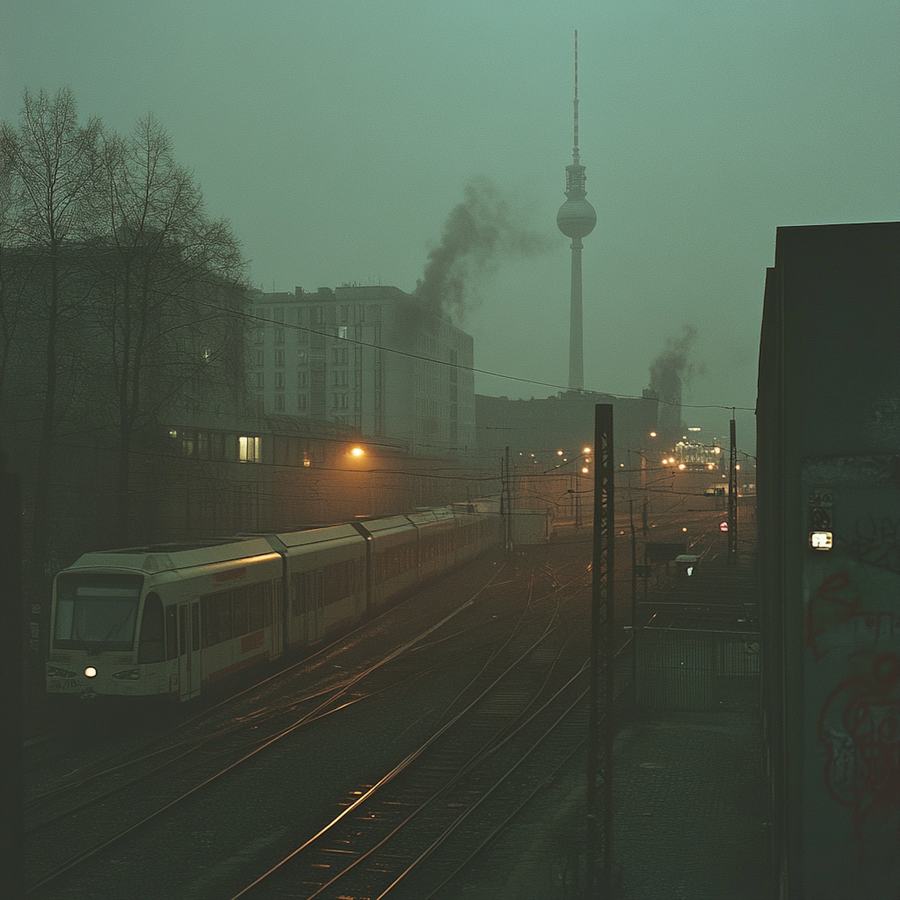
Banned In Berlin
Press Release
“Banned In Berlin” — Mr. Dawzo
Press Release
“Banned In Berlin” is not merely an experimental synthesizer recording — it is a sonic artifact pulled from the psychological rubble of the Cold War.
Recorded in 2018 inside a hotel room overlooking Potsdamer Platz in Berlin, the nearly fourteen-minute improvised piece documents Mr. Dawzo’s first encounter with a raw Soviet-era Polivoks analog synthesizer: a notoriously unstable machine often described as the Eastern Bloc’s answer to the Moog, though far more violent, unpredictable, and psychologically unhinged in character.
The instrument itself arrived under circumstances that already felt half mythical.
While traveling across Europe en route to Russia, Mr. Dawzo located the Polivoks through a seller in Croatia and had it shipped directly to his Berlin hotel room — a strange modern pilgrimage involving border crossings, underground electronics history, Cold War mythology, and a machine once born behind the Iron Curtain. Shortly afterward, the synthesizer would continue eastward to Moscow, where it was eventually refurbished by the team at ELTA Music, modern caretakers of a uniquely Soviet electronic legacy.
What emerged from those Berlin sessions was not a traditional composition, but an act of exploration — a live improvised descent into circuitry, instability, and historical memory.
“Banned In Berlin” captures the sound of someone learning the personality of the machine in real time: oscillators drifting like failing transmission towers, distorted filter sweeps collapsing into mechanical screams, primitive pulses resembling distant military sirens or industrial machinery echoing through abandoned concrete corridors. At moments the synth seems alive; at others, barely functioning.
That tension is the point.
Unlike polished Western synthesizers designed for precision and musical obedience, the Polivoks has long been revered for its crude aggression and unstable emotional character. Its sound feels less engineered than excavated — harsh, volatile, claustrophobic, and deeply human in its imperfections. In “Banned In Berlin,” those textures become emotional architecture.
The track unfolds like a journey through invisible historical geography: East Berlin shadows, Soviet apartment blocks, underground train tunnels, rusting factories, border checkpoints, state radio interference, frozen industrial landscapes, and the psychic exhaustion lingering beneath late-stage Cold War modernity.
Particular inspiration came from the story of Soviet engineer Vladimir Kuzmin and the Formanta factory, where Western synthesizer concepts were reverse-engineered behind the Iron Curtain and transformed into uniquely Soviet instruments that carried their own aesthetic identity — less sleek futurism, more survivalist machinery humming beneath political tension.
Rather than approaching this history academically, “Banned In Berlin” absorbs it emotionally.
The recording intentionally preserves the roughness of the session: knob movements, unstable tuning, abrasive frequency collisions, sudden shifts in atmosphere, and long hypnotic passages where the machine seems to drift between meditation and system failure. The result feels closer to found audio from a forgotten Eastern Bloc laboratory than a contemporary electronic release.
Yet beneath the harshness lies fascination and reverence.
“Banned In Berlin” is ultimately about movement across borders — geographical, historical, technological, and psychological. It traces a line from East Germany to Moscow, from analog circuitry to emotional memory, from Cold War paranoia to modern digital alienation.
The title itself suggests both censorship and mythology: something too strange, too unstable, too politically charged to comfortably exist inside clean modern systems.
Dark, immersive, and unapologetically raw, “Banned In Berlin” stands as one of the most historically textured entries in the Dawzo catalog — a longform experimental synth piece where broken circuitry, post-Soviet atmosphere, and analog noise become a kind of haunted historical poetry.
Lyrics
Instrumental / no lyrics supplied.